THE TJC EXECUTIVE BRIEF | ISSUE 05
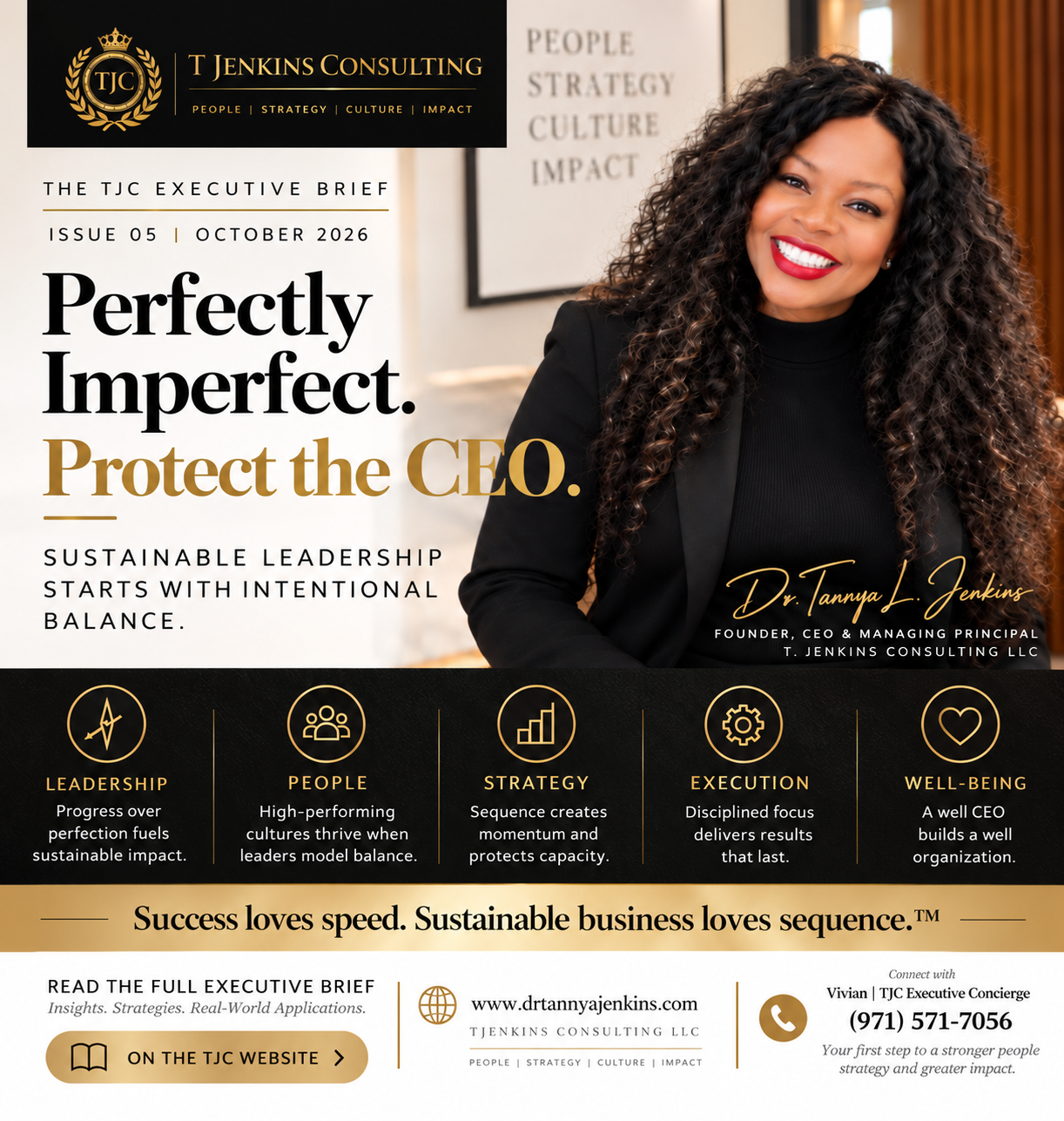
Perfectly Imperfect. Protect the CEO.™
THE TJC EXECUTIVE BRIEF | ISSUE 05
October 2026
Why Sustainable Growth Requires More Than Executive Excellence
People | Strategy | Culture | Impact
There is a quiet tension in executive leadership that rarely makes its way into the strategic plan.
The very qualities that help founders and CEOs build successful organizations—vision, determination, accountability, responsiveness, and an unwavering commitment to excellence—can eventually become the qualities that constrain growth.
Not because those qualities are wrong.
But because the organization has become too dependent on the person who embodies them.
The CEO was never meant to be the entire operating system.
The Leadership Challenge I See Too Often
As a leader of leaders, I have the privilege of partnering directly with founders, CEOs, and executive teams navigating the complexities of organizational growth, transformation, and operational excellence.
One challenge I encounter repeatedly is the tension between a leader's commitment to excellence and the organization's growing dependence on that leader.
These executives are often highly capable, deeply committed, and extraordinarily invested in the success of their organizations.
Yet they find themselves managing competing priorities, resolving recurring operational challenges, making decisions that should reside elsewhere, and carrying responsibilities that have outgrown the organization's leadership infrastructure.
What begins as dedication can gradually become dependency.
And when the organization depends too heavily on the CEO, both the leader and the enterprise become constrained.
In my executive advisory and fractional leadership work, I partner closely with founders and CEOs to identify these constraints, address their underlying causes, and design practical solutions that strengthen organizational capability while protecting executive capacity.
The objective is not simply to make the CEO more productive.
It is to build an organization that can operate, perform, and grow without requiring the CEO's constant intervention.
What the Research Tells Us
Research reinforces the importance of intentional executive capacity management.
In their Harvard Business Review study, How CEOs Manage Time, Michael E. Porter and Nitin Nohria examined nearly 60,000 hours of activity across 27 CEOs.
Their findings highlighted the extraordinary demands placed on chief executives and the importance of deliberately allocating time across strategic priorities, organizational leadership, relationships, and operational responsibilities.
The research underscores a fundamental leadership reality: how CEOs invest their time shapes how their organizations function.
Similarly, Gallup's State of the Global Workplace: 2024 Report highlights the critical influence managers have on employee engagement and organizational performance.
Gallup's broader research has found that managers account for approximately 70% of the variance in team-level engagement.
This reinforces the importance of building strong management capability throughout the organization rather than relying exclusively on executive influence.
Together, these findings support an important distinction:
Effective executive leadership is not measured by how much the CEO personally manages, but by how effectively leadership capability is developed and distributed throughout the enterprise.
Perfectly Imperfect Leadership
Executive excellence does not require perfection.
It requires clarity, sound judgment, disciplined execution, and the humility to recognize that sustainable success must extend beyond any single leader.
Perfectly imperfect leadership acknowledges that:
Not every decision requires the CEO.
Not every process needs to be personally managed.
Not every opportunity deserves immediate pursuit.
Not every responsibility should remain with the founder.
Not every imperfection represents a failure of leadership.
The goal is not to lower standards.
The goal is to build an organization capable of maintaining those standards without constant executive intervention.
Protecting the CEO Is a Business Strategy
CEO capacity is an enterprise resource.
It should be invested where executive judgment, relationships, and strategic leadership create the greatest value.
When leaders spend disproportionate time resolving routine operational issues, coordinating administrative activities, or repeatedly making decisions that could be delegated, the organization pays an opportunity cost.
That cost may appear as delayed growth, slower decisions, inconsistent execution, reduced innovation, or leadership fatigue.
Protecting the CEO is therefore not about reducing accountability.
It is about designing accountability into the organization.
This is where intentional executive advisory becomes particularly valuable.
Through my work with founders and CEOs, I focus on identifying the organizational structures, leadership practices, and operating systems that may be limiting executive effectiveness.
Together, we work to clarify priorities, strengthen decision rights, establish accountability, build leadership capability, and create the operational infrastructure required for sustainable performance.
The ultimate objective is to move the organization from founder dependency toward enterprise capability.
The TJC SCALE Principle
At T. Jenkins Consulting, we believe sustainable growth requires intentional operating architecture.
Our TJC SCALE Principle provides five disciplines for building that foundation:
S — Systematize Judgment
Document recurring decisions, standards, and operating expectations so the organization can execute consistently.
C — Clarify Decision Rights
Define who owns decisions, who provides input, and when escalation is necessary.
A — Assign and Delegate Execution
Place accountability with capable leaders and teams, supported by clear outcomes and appropriate authority.
L — Leverage Systems & Smart Automation
Establish repeatable, measurable processes and selectively leverage technology, automation, or AI where appropriate to improve efficiency, strengthen execution, and expand leadership capacity.
E — Elevate and Protect the Executive
Preserve CEO capacity for strategy, critical relationships, enterprise leadership, and decisions that genuinely require executive attention.
The objective is not to remove the CEO from the business.
It is to ensure the business can operate effectively without requiring the CEO to be everywhere.
Technology Should Create Capacity, Not Complexity
Systematic process improvement, operational automation, and artificial intelligence offer meaningful opportunities to modernize organizational operations, strengthen execution, and expand leadership capacity.
But modernization does not require every organization—or every leader—to embrace the same tools, technologies, or pace of change.
As a leader of leaders, I recognize that founders and CEOs bring different experiences, leadership philosophies, risk tolerances, and levels of technological readiness to the table.
Our objective is not to force technology adoption. It is to identify the most effective path forward for each leader and organization.
Sometimes that means simplifying a process.
Sometimes it means documenting a repeatable workflow, establishing measurable performance standards, clarifying decision rights, or delegating responsibilities to capable team members.
Other times, it means introducing practical automation or thoughtfully governed artificial intelligence to reduce administrative burdens and create additional capacity.
The common denominator is intentionality.
Through my work with founders and CEOs, I help leaders identify opportunities to transform recurring activities into repeatable, measurable, and sustainable operating systems—freeing valuable executive time for strategic thinking, relationship building, innovation, and enterprise leadership.
The goal is not simply to do more with less.
The goal is to multiply leadership effectiveness without multiplying executive workload.
Technology is one possible enabler. It is not the destination.
The sequence matters.
Simplify the work. Clarify accountability. Establish repeatable systems. Measure performance. Introduce automation where it creates meaningful value.
And always preserve the human judgment, relationships, and trust that sustainable leadership requires.
Because the strongest operating systems do more than improve efficiency.
They create organizational capability that extends beyond the individual leader.
The Executive Reflection
As you consider the next stage of your organization's growth, ask yourself:
What decisions still depend on me that should no longer require my involvement?
Where has my personal commitment to excellence unintentionally created organizational dependency?
What could we delegate, document, or responsibly automate to create greater capacity?
If I stepped away for two weeks, what would continue operating effectively—and what would stop?
The answers reveal more than opportunities for efficiency.
They reveal the organization's readiness to scale.
The Bottom Line
Over the course of my leadership journey, one principle has become increasingly clear:
The most effective leaders do not simply build successful organizations. They build organizations capable of sustaining success beyond their constant involvement.
As a leader of leaders, my work is centered on helping founders, CEOs, and executive teams make that transition intentionally.
Because sustainable growth should not come at the expense of executive well-being, organizational trust, or operational excellence.
The strongest executives do not build enterprises that depend on their constant availability.
They build enterprises where leadership, accountability, culture, and execution are intentionally designed to endure.
Success loves speed. Sustainable business loves sequence.™
And sustainable leadership requires the courage to build beyond yourself.
Perfectly Imperfect. Protect the CEO.™
Research & Executive Insights
1. Porter, M. E., & Nohria, N. (2018). How CEOs Manage Time. Harvard Business Review, July–August 2018.
https://hbr.org/2018/07/how-ceos-manage-time
2. Gallup. (2024). State of the Global Workplace: 2024 Report.
https://www.gallup.com/workplace/349484/state-of-the-global-workplace.aspx
Dr. Tannya L. Jenkins
Founder, CEO & Managing Principal
T. Jenkins Consulting LLC
Fractional Executive Leadership | Executive Advisory & Organizational Strategy | Leadership & Culture Transformation
People | Strategy | Culture | Impact
