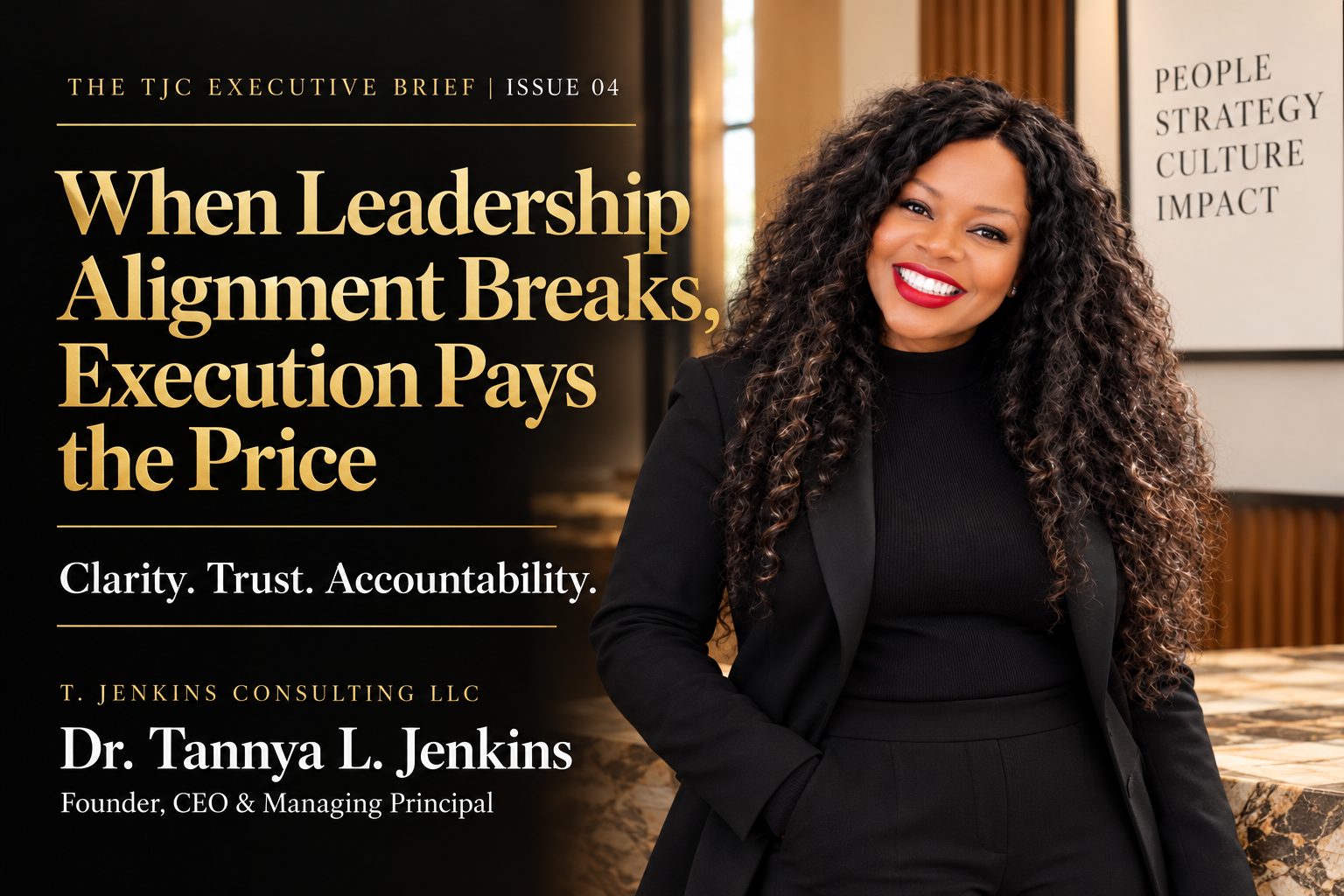
THE TJC EXECUTIVE BRIEF | ISSUE 04
T. JENKINS CONSULTING LLC
Executive Advisory | Organizational Strategy | Leadership & Culture Transformation
When Leadership Alignment Breaks, Execution Pays the Price
Why strategic clarity, organizational trust, and executive accountability must operate together.
Organizations rarely struggle because their leaders lack ambition.
They struggle when ambition is not translated into shared priorities, coordinated decisions, and consistent execution.
A compelling vision may inspire an organization. A well-developed strategy may establish its direction. But neither guarantees results when executive leaders interpret priorities differently, compete for resources, or operate with conflicting expectations.
The true cost of leadership misalignment is not always immediately visible on the balance sheet. It often appears first in delayed decisions, duplicated work, declining trust, organizational fatigue, and missed opportunities.
By the time those consequences become measurable, the organization may already be paying a significant execution premium.
For CEOs and boards, leadership alignment must therefore be treated as an enterprise performance responsibility, not simply a leadership development initiative.
The Alignment Gap: What the Research Reveals
Research has repeatedly demonstrated the challenges organizations face when translating strategy into coordinated action.
Research highlighted by MIT Sloan found that only 28% of executives and middle managers responsible for strategy execution could identify three of their organization's strategic priorities.
Consider the implications.
If the leaders responsible for translating strategy into operational outcomes cannot consistently articulate what matters most, how confidently can the organization allocate resources, evaluate trade-offs, or hold teams accountable?
More recent research underscores the human dimension of this challenge.
Gallup’s State of the Global Workplace: 2026 reported that global employee engagement declined to 20% in 2025, while manager engagement fell to 22%.
These findings do not establish that executive misalignment caused the engagement decline. They do, however, reinforce the importance of examining the organizational conditions under which managers are expected to deliver results.
The strategic question is no longer simply whether leaders understand the vision.
It is whether the organization has the leadership alignment, trust, and operating discipline required to execute that vision consistently.
Three Ways Leadership Misalignment Erodes Performance
1. Strategic priorities become competing agendas.
When executive leaders lack a shared interpretation of enterprise priorities, functional excellence can unintentionally undermine organizational performance.
Finance prioritizes cost containment. Operations prioritizes efficiency. People leadership prioritizes workforce capability. Commercial leadership prioritizes growth.
Each objective may be legitimate.
The challenge emerges when these priorities are pursued independently rather than reconciled against a shared enterprise strategy.
The result is organizational friction disguised as functional productivity.
Executive alignment does not require every leader to think alike. It requires leaders to make decisions from a shared understanding of what the enterprise must accomplish.
2. Trust deteriorates when leadership behavior contradicts organizational commitments.
Employees evaluate leadership credibility through more than executive communications.
They observe whether decisions reflect stated values, whether accountability is applied consistently, and whether leaders demonstrate the behaviors they expect from others.
When organizational commitments and leadership behavior diverge, trust becomes vulnerable.
Google’s Project Aristotle research identified psychological safety as a particularly important characteristic of effective teams.
For executive leaders, the implication is significant: organizations need environments where people can raise concerns, challenge assumptions, and surface emerging risks without unnecessary interpersonal fear.
Yet psychological safety should not be confused with an absence of accountability.
High-performing organizations need both.
Trust creates the conditions for candid dialogue. Accountability ensures that dialogue translates into responsible action.
3. Execution slows when decision rights and ownership remain unclear.
Even well-aligned leadership teams can experience execution failure when decision-making authority is ambiguous.
Projects stall while leaders seek additional approvals.
Teams revisit decisions that should already be settled.
Resources remain committed to initiatives that no longer support enterprise priorities.
Over time, the organization develops a costly pattern: significant activity without corresponding strategic progress.
This is why executive alignment must extend beyond shared intentions.
It must become visible in operating rhythms, decision rights, resource allocation, performance measures, and leadership accountability.
From Executive Agreement to Organizational Alignment
In my work across executive leadership, organizational strategy, and People & Culture transformation, I view alignment as an ongoing leadership responsibility—not a one-time planning exercise.
Executive teams must continually connect strategic intent with organizational behavior and measurable outcomes.
This requires discipline in three areas.
Strategic clarity. Leaders must understand the enterprise's most important priorities, the trade-offs those priorities require, and the outcomes that define success.
Leadership consistency. Executive behaviors, decisions, and organizational commitments must reinforce one another. Trust cannot be sustained through messaging alone.
Execution accountability. Clear ownership, decision rights, operating rhythms, and meaningful performance indicators must translate strategic priorities into coordinated action.
These principles also inform the leadership philosophy behind T. Jenkins Consulting's proprietary LEGACY Leadership Compass™ and LEGACY Leadership Operating System™.
Our approach recognizes that sustainable organizational performance requires intentional alignment between leadership, culture, strategy, and execution.
The objective is not simply to help organizations move faster.
It is to help them move forward with greater clarity, confidence, and organizational coherence.
The Executive Leadership Challenge: Three Questions Worth Asking
As your leadership team prepares for its next strategic planning or performance review, consider three questions:
1. Are we truly aligned on our three most important enterprise priorities?
Ask each executive to independently identify those priorities, explain the required trade-offs, and describe how success will be measured.
Differences in interpretation may reveal execution risks before they become performance problems.
2. Do our leadership behaviors reinforce the culture and accountability we expect?
Examine whether decisions, resource commitments, communication practices, and performance expectations consistently reflect the organization's stated values.
Look beyond what leaders say.
Evaluate what the organization experiences.
3. Have we established the operating discipline required to execute?
Determine whether every strategic priority has a clearly accountable executive, defined decision authority, measurable milestones, and a consistent review cadence.
Where ownership is unclear, execution risk increases.
The Next 30 Days: Make Alignment Measurable
Rather than introducing another enterprise-wide initiative, begin with a focused executive alignment review.
During the next 30 days:
Clarify: Validate the three most important enterprise priorities and identify competing interpretations.
Align: Confirm executive ownership, critical dependencies, and decision-making authority.
Activate: Establish a consistent leadership review rhythm with measurable outcomes and explicit accountability.
The objective is not to create more meetings or additional reporting.
It is to improve the quality, consistency, and speed of enterprise decisions.
Alignment becomes valuable when it changes how leaders lead, and how the organization executes.
The CEO Imperative
In today's environment of accelerating technological change, workforce complexity, and increasing performance expectations, executive alignment cannot remain an assumed condition.
It must be intentionally built, consistently reinforced, and continuously evaluated.
The organizations best positioned for sustainable performance will not necessarily be those with the most ambitious strategies.
They will be those whose leaders can translate strategic ambition into shared commitment, trusted leadership, and disciplined execution.
Because when leadership alignment breaks, execution pays the price.
And when leadership alignment strengthens, organizations create the conditions for sustainable performance.
CAST THE VISION. CREATE ALIGNMENT. BUILD WITH INTENTION. LEAD WITH TRUST. EXECUTE WITH EXCELLENCE.™
Executive Advisory | T. Jenkins Consulting LLC
Is your leadership team aligned around the strategy or simply operating from the same strategic plan?
At T. Jenkins Consulting LLC, we partner with CEOs, executive teams, and organizations navigating growth, transformation, and organizational complexity.
Through executive advisory, organizational strategy, fractional executive leadership, and leadership and culture transformation, we help organizations strengthen strategic alignment, organizational trust, and execution discipline.
If your organization is navigating a critical transition, experiencing execution friction, or preparing for its next stage of growth, let's begin a strategic conversation.
Connect with Dr. Tannya L. Jenkins
Founder, CEO & Managing Principal
T. Jenkins Consulting LLC
Serve with excellence. Build with intention. Execute with speed.
Research & Executive Reading
MIT Sloan, A Guide to MIT Sloan Management Review's Strategic Agility Project (2019). https://mitsloan.mit.edu/ideas-made-to-matter/a-guide-to-mit-sloan-management-reviews-strategic-agility-project
Gallup, State of the Global Workplace: 2026 (2026). https://www.gallup.com/workplace/349484/can-work-from-home-sometimes.aspx
Google re, Understand Team Effectiveness: Project Aristotle. https://rework.withgoogle.com/en/guides/understanding-team-effectiveness
© 2026 T. Jenkins Consulting LLC. All rights reserved.
LEGACY Leadership Compass™ and LEGACY Leadership Operating System™ are proprietary frameworks of T. Jenkins Consulting LLC.
